What do you do when an AI deepfake has your face?
A New Orleans doctor spent months trying to get fake AI ads of himself taken down. What worked, what didn't, and why the settings you've heard about wouldn't have helped.

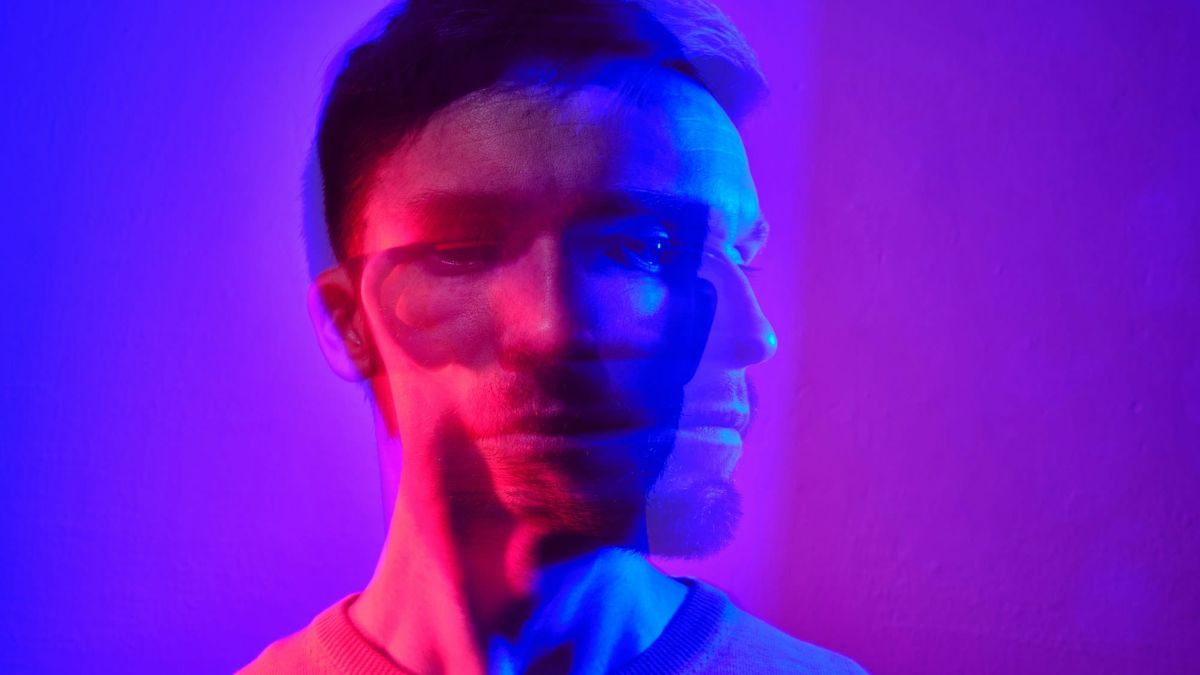
A friend sent Dr. Maurice Sholas a TikTok of himself selling vitamins. There he was in a lab coat, his own name stitched on it, telling viewers that a supplement called K2D3 was something their bodies needed. He never said any of it. Someone had taken a clip from one of his real videos, ran it through AI, and put new words in his mouth. The word for this is a deepfake.
Sholas is a real pediatric physician in New Orleans. The product was real too, and the fake ads were aimed at Black viewers specifically. The ad was claiming the supplements mattered "because they're Black." At least one person he knows bought a bottle believing the recommendation came from him. Fake faces make real money, which is exactly why these ads keep getting made.
So he set about getting the videos taken down. He complained to the account posting them. They removed nothing. They edited the videos instead, aging his face and changing his teeth just enough to argue it wasn't him. He reported it to TikTok and received silence. Sholas described his attempt in just a few words: "I don't have a PR firm. So TikTok just ignored me." He finally called a journalist friend at a New Orleans TV station, and hours after the newsroom reached out for comment, TikTok banned the account.
By then copies had spread to Instagram and X. Instagram ignored his reports too. On a lawyer's advice he paid for a verified checkmark, hoping it would make his reports count for something. He calls that paying "for the privilege of being me." It didn't help. The scammers blocked him, so he couldn't even see whether the fakes were still up. When he asked what professional cleanup would cost, the reputation firms quoted between $9,000 and $20,000.
If your first instinct is to ask which privacy setting he forgot to turn off, I had the same thought. But there wasn't one to forget. No setting anywhere covers someone feeding your public videos into an AI tool and posting the results from an account you've never heard of.
We covered the one Instagram setting worth turning off when Meta pulled its AI image feature earlier this month. That toggle is still worth your thirty seconds. It stops one company from reusing your posts in one set of features. What happened to Dr. Sholas happened outside every settings menu.
The report buttons were built for a different problem
Every big platform has an impersonation report, and the policies all describe the same situation: someone created an account pretending to be you. A cloned profile using your name and photos. For that, the forms work. Instagram's asks for a government ID and confirmation that an account is "pretending to be you." X requires an account posing as you. TikTok's covers "accounts that pose as another real person."
An AI ad with your face, posted by a real account that never claims to be you, is none of those things. It isn't a fake account. It usually isn't intimate imagery, which has its own removal process. And unless you filmed the original clip yourself, it isn't your copyright either. It falls between every category the report menus offer. There is no right form for what happened to Dr. Sholas.
YouTube is the one exception. Since 2024, its privacy complaint process has covered AI content that "looks or sounds like you," in those words. You file, the uploader gets 48 hours to take it down themselves, and then YouTube reviews it. Removal isn't guaranteed. But it's the only big platform with a request form built for this, and that makes it the one place to start with a form instead of a prayer.
The law assumes somebody is selling something
The legal right at play here is called the right of publicity: your ability to control commercial use of your name, face, and voice. Thirty-seven states recognize it in some form. Read the fine print, though, and the operative word is commercial. In most states, if nobody is selling anything, you have no claim. Someone generating images of you for laughs breaks no law in most of the country. (California reaches further than most, and which state you live in matters more than it should.)
The new AI likeness laws you may have heard about were built for someone else. Tennessee's ELVIS Act protects voice and likeness, written with recording artists in mind. California passed protections for performers and for dead celebrities. New York's digital replica law covers deceased performers. A living, ordinary person whose face turns up in an AI video sits outside most of it.
Federal law is thinner still. A New York court ruled last year, in a case brought by two voice actors whose voices were cloned, that copyright and trademark law don't protect a face or a voice at all. What survived in that case were state claims. The one federal law that did pass, the TAKE IT DOWN Act, requires platforms to remove intimate images within 48 hours, and it has teeth, but it covers only intimate images. A fake ad, a meme, a "harmless" remix of your face all sit outside it. And the FTC has had a rule on its desk since early 2024 that would make impersonating an individual a federal violation. As of this month it still isn't finished.
One bill would change the picture: the NO FAKES Act, which would give every American, famous or not, a right over digital replicas of themselves, with a takedown process attached. It cleared a Senate committee unanimously in June. It is not law, no floor vote is scheduled, and the House version hasn't moved. Watch it, but don't wait on it.
When the law works, money changed hands
Kaelyn Lunglhofer was 19 when a dating app called Meete took ten seconds from the TikTok she posted on her high school graduation day, put its branding on it, and added a voiceover asking if viewers wanted "a friend with benefits." The app aimed the ad at men near her location. She found out when a guy in her own dorm sent it to her.
She's suing in federal court, and she has a real case for one reason: the app used her face to sell something. Commercial use is the hook her lawyers can hang claims on, including Tennessee's ELVIS Act. The catch is that the companies behind the app are registered in the British Virgin Islands and China. You can have the strongest likeness claim in America and still be chasing a defendant no American court can easily reach.
And when a face does get licensed properly, look at the price list. Scott Jacqmein, a 52-year-old Dallas actor, was paid about $750 plus a trip to California for the rights to his AI avatar. The avatar has since pitched insurance quotes, horoscope apps, and a supplement he'd never heard of, once in fluent Spanish. He doesn't speak Spanish. The one fake he managed to get removed came down through an ordinary YouTube complaint. TikTok's biggest star, Khaby Lame, sold rights tied to an AI twin of himself in a deal valued at $975 million. The going rate for a face depends on whose face it is.
What actually works right now
The full step-by-step takedown guide is now its own post: How to get a deepfake of you taken down. The short version:
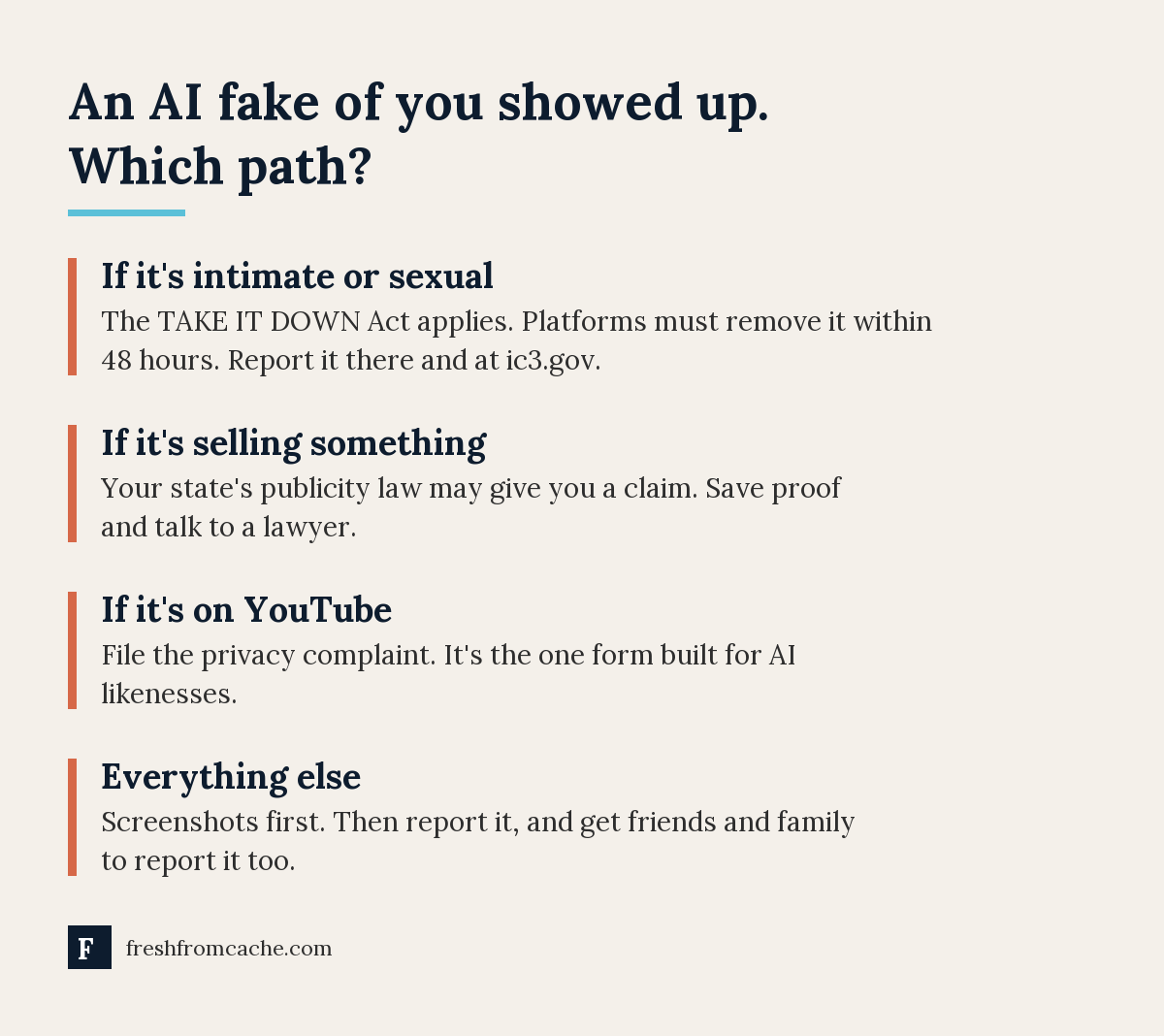
- Save everything first. Screenshots, links, dates, the account name, who saw it. Every path that works starts with proof, and content like this tends to vanish and reappear somewhere else.
- On YouTube, use the privacy complaint. It's the one form on any big platform written for AI likenesses. It's in YouTube's help pages under "Protecting your identity."
- Everywhere else, report it anyway, and don't do it alone. Ask friends and family to report the same posts. In Dr. Sholas's case, what finally moved TikTok was a newsroom asking questions, and I won't pretend otherwise: attention works.
- If it's selling something, talk to a lawyer. Commercial use is where your state's publicity law may give you an actual claim, especially if the advertiser is a US company.
- If it's intimate or sexual, it's a different situation. The TAKE IT DOWN Act requires removal within 48 hours. Report it to the platform and at ic3.gov, the FBI's complaint center.
There are also paid services now, some with free tiers, that monitor for your face and file takedowns for you. The biggest one claims a 95 percent success rate. Nobody independent has verified that number, so take it as what it is: the company's own claim about itself. A market is forming to sell people the protection the law doesn't provide. Whether it delivers is an open question.
Where this leaves us
People finding ugly uses for a new technology is an old story, and the law running years behind is an even older one. I expected both. What made me angry, reading about Dr. Sholas, was the wall he hit at every company: no person to talk to, no path that treated him like a human being with a real problem. He ended up paying for a checkmark in hopes it came with someone who would listen. I've done the same thing, paid for verification just to get a problem in front of a person. That's buying customer service that should come with the product. These platforms built the tools that make fakes this easy. A working way to report one should be built.
The NO FAKES Act will probably become law in some form, and it will build the road: a federal likeness right, a takedown process, penalties for platforms that ignore it. My worry is scale. The old version of this scam took real time and effort per victim. Now one person can generate a million fakes with the click of a button. Facebook and Twitter both hit a wall when moderation outgrew them, and this wave is bigger and more personal. When the queue overflows, the people with PR firms and lawyers get through it. The rest of us are the ones who fall through the cracks.
So if you're wondering whether to stop posting your face, or your grandkids, my answer is no. The odds of this catching any one of us are still low. Post with it in mind, the way you lock the car without expecting a break-in. And pay attention to how the companies and the lawmakers handle this, because we're the ones who will live with the answer, and we do get a vote.
If a fake of you or someone you love shows up tomorrow, the screenshots come first, before the reporting and before the phone calls. Everything that eventually worked, for the doctor and the student both, started with being able to show what ran and where.
Sources
- AARP, The Perfect Scam: "Deepfake Doctors: AI-Generated Medical Ad Scams" (April 24, 2026)
- The New York Times: "He Sold His Likeness. Now His Avatar Is Shilling Supplements on TikTok." (August 17, 2025)
- CyberScoop: coverage of Lunglhofer v. Meete, E.D. Tenn., filed April 28, 2026
- YouTube Help: "Protecting your identity"
- Meta Transparency Center: Meta AI Verification Terms
- U.S. Copyright Office: Copyright and Artificial Intelligence, Part 1: Digital Replicas (July 2024)